Sunday, December 23, 2012

A Savvy Ecocosmological Earth Calendar

The concept of axial precession
Only one calendar I know of synchronizes with the Earth's axial precession.

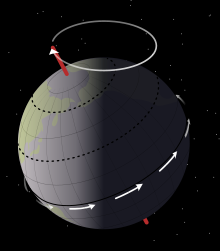
The graphic to the left depicts that phenomenon, described as "Precessional movement of the Earth. The Earth rotates (white arrows) once a day about its axis of rotation (red). This axis itself rotates slowly (white circle), completing a rotation in approximately 26,000 years" (ibid).

The phenomena of axial precession and axial tilt are important for civilizations to take into consideration in their long range planning.

Or for that matter any planning that is based on ecological / environmental phenomena that have a meaningful impact on civilization.

One calendar that does so is the Mesoamerican Long Count Calendar since it has a method of synchronizing with axial precession as follows:
1 Day = Kin (keen)
20 Kin  = 1 Uinal (a.k.a. Winal)
360 Kin or 18 Uinals = 1 Tun (toon)
20 Tuns = 1 K’atun (k’a toon)
20 K`atuns or 400 Tuns = 1 Baktun (backtoon)

13 Baktuns or 5,200 Tuns = 1 Great Cycle
5 Great Cycles  = 26,000 Tuns (~26,000 yr. axial precession)

(see e.g. Mayan Long Count, and Mesoamerican Long Count). We can calculate how close the Long Count Calendar is to the axial precession cycle:
Earth's axial precession = 25,771 years
26,000 Tun * 360 Kin per Tun / 365.25 solar days = ~25,626 years
25,771 years - 25,626 years = 145 years (axial precession variation)
145 is ~0.56% of 25,771 (very slight degree of variation)

(see e.g. Precession of the Equinox). Therefore, the 26,000 Tun figure is within about a half of one percent of being equal to one complete cycle of the Earth's axial precession as calculated by other astronomical means (we don't know which of the two is more accurate, but a ~0.56% variance between the two is not significant).

[Note that current calendars of civilization do not even take axial precession into consideration at all.]

Another factor of the Long Count Calendar is that "Thirteen b’ak’tuns made up a Great Cycle, which adds up to 5,200 tuns" (Mayan Calendar Portal).

So much was falsely made about a "Mayan apocalypse" on December 21, 2012, because it was the end of a 5,200 Tun Great Cycle (the next Great Cycle of 5,200 Tuns began on the next day, December 22, 2012).

Anyway, that Great Cycle concept is an additional helpful factor because the 26,000 Tun cycle is segmented into five Great Cycles of 5,200 Tun each (5,200 x 5 = 26,000).

Since five Great Cycles make up one 26,000 Tun cycle, and that relates to one cycle of the axial precession of the Earth, we can segment the cycle of axial precession into five segments or sections of time using The Long Calendar.

Why does any of this matter, and what does it have to do with a good or bad calendar, in terms of long range planning by civilizations?

The first factor to consider is the axial tilt:
The Earth's axis remains tilted in the same direction with reference to the background stars throughout a year (throughout its entire orbit).

This means that one pole (and the associated hemisphere of the Earth) will be directed away from the Sun at one side of the orbit, and half an orbit later (half a year later) this pole will be directed towards the Sun.

This is the cause of the Earth's seasons.

(Wikipedia, Axial Tilt). Next consider what happens when the axial tilt rotates during the cycle of axial precession:
Variations in Earth's axial tilt can influence the seasons and is likely a factor in long-term [non-anthropogenic] climate change.

(ibid). Thus, the Long Range Calendar would divide the 26,000 Tuns into five segments of 5,200 Tuns each, which would give such a calendar the utility to help civilizations determine when and how ecocosmological climate change, i.e., natural cosmic climate change would take place in the different hemispheres of the Earth.

Why is that important?

Because it would tell, among other things, when polar ice caps would naturally melt to cause natural sea level rise that would flood coastal areas, when the poles would naturally ice-over to again cause natural sea level drop once again, how the flora and fauna would begin to adapt as those climate changes gently and slowly began to take place, as well as many other fundamental things civilizations need to know to happily survive on a planet like the Earth (see e.g. this and this).

Wise civilizations would use a long term calendar for long term planning in terms of zoning, when and where to build, when and where not to build, how to build for the current and next cycle, and therefore how to avoid a lot of waste, destruction, loss of life, as well as avoiding great, unnecessary expense.

[This all assumes that any Earth civilizations would not cause anthropogenic global warming induced climate change, as current civilization already has done, to a very reasonably predictable Earth environment.]

In closing, let me say that that this post emphasizes the utility of the Mesoamerican Long Calendar, but more than that, it makes it obvious how unwise the current civilization is to always assume that older nations, peoples, and eras were inferior to us in wisdom, vision, and intelligence.

The next post in this series is here.

Video shows ~26,000 Tun / Year axial procession cycle:


Saturday, December 22, 2012

A Lovely Planet In The Neighborhood? - 3

Oh, it is just down the block
In this series we have been noting the vast distances to planets that some astronomers loosely call "in our neighborhood" or "near us."

In previous posts regular readers know that we have pointed out how travel to those planets would take orders of magnitude more time than we have, in fact it would take more time than homo sapiens have even existed, which is about 200,000 years.

The pop science rags tell us things like "The extrasolar planet, now named GJ 1214b, is about 40 light-years away ... Astronomically speaking, this [planet] is on our block" or they might say that they have found a planet "near us."

Ecocosmology Blog has consistently pointed out that these planets are well out of our reach, and in fact impossible for us to reach since we have opted to stick with propulsion systems thousands of years old (see A Lovely Planet In The Neighborhood? and A Lovely Planet In The Neighborhood? - 2).

Now, two new planets have been detected that are even more "near" than previous ones we have discussed.

Those new discoveries are 12 light years and 4.4 light years away.

If we calculate using the arithmetic in the two Ecocosmology Blog posts linked to above, the number of years required to go to the planet 12 light years away would be 211,774.36 years ONE WAY.

Likewise, the planet "only" 4.4 light years away would "only" take 77,650.60 years ONE WAY.

Why don't we settle on going to Mars first, as we figure out a realistic mode of transportation for meaningful space travel?

The previous post in this series is here.


Saturday, December 1, 2012

What Kind of Intelligence Is Prescience?

This post begins a series concerned with prescience ("pre" + "science"), a facet of intelligence that is composed of various degrees of "vision", i.e., the ability to see where any particular behavior will end up.

A primitive example of that facet of intelligence would be to know what would happen if one jumped off a high cliff or drank poison:
Federal officials have given energy and mining companies permission to pollute aquifers in more than 1,500 places across the country, releasing toxic material into underground reservoirs that help supply more than half of the nation's drinking water.

(Poisoning The Well). Young toddlers generally do not develop that type of vision until they age and experience life for awhile, but adults should have adult sense or else they are simply incompetent.

So it is at once clear that prescience or vision develops with time, but it also develops at different levels and rates in each individual (e.g. "visionary: a person of unusually keen foresight").

This blog has a policy of not being bigoted against either science or religion (see e.g. Message of Science & Religion - Western) because people in both of those realms at one time or another make mistakes (see e.g. Weekend Rebel Science Excursion - 12).

It would not be wise to reject a person merely because they make mistakes, but it would be wise to question them should they embrace that mistake and descend into denialism, obsessing that the mistake is not a mistake.

One prime example is global warming induced climate change, where deniers typically come from a fundamentalist environment, often associating that fundamentalism with "the Bible."

So, for today's post let's look at a few examples of text from that compilation of ancient writings now in the form of a library (it is composed of many books) to see if there is any prescience about global warming induced climate change in those ancient writings:
Isaiah 24:4-6 - "The earth dries up and withers, the world languishes and withers, the exalted of the earth languish. The earth is defiled by its people; they have disobeyed the laws, violated the statutes and broken the everlasting covenant. Therefore a curse consumes the earth; its people must bear their guilt. Therefore earth's inhabitants are burned up, and very few are left."
...
Jeremiah 2:7 - "I brought you into a fertile land to eat its fruit and rich produce. But you came and defiled my land and made my inheritance detestable."
...
Ezekiel 34:17-18. "As for you, my flock ... Is it not enough for you to feed on good pasture? Must you also trample the rest of your pasture with your feet? Is it not enough for you to drink clear water? Must you also muddy the rest with your feet?"
...
Job 12:7-10. "But ask the animals, and they will teach you; or birds of the air and they will tell you; or speak to the earth and it will teach you; or let the fish of the sea inform you. Which of all these does not know that the hand of the lord has done this. In His hand is the life of every creature and the breath of all mankind."
...
Rev. 11:18. "The time has come for judging the dead, and for ... destroying those who destroy the earth" (NIV); "... the time for the dead to be judged, and for ... destroying the destroyers of the earth” (ESV); "the time of the dead, that they should be judged, and that thou shouldest ... destroy them which destroy the earth" (KJV); "your wrath is come, and the time of the dead, that they should be judged, and that you should ... destroy them who destroy the earth." (KJV - 2k)

These are ancient writings of what appears to be prescience recorded by those exposed to some form of visionary intelligence warning about the value of the Earth as well as the consequences for a lack of understanding about it.

More modern visionaries have written similar things that could be considered warnings too:
“The end of the human race will be that it will eventually die of civilization.”- Ralph Waldo Emerson

(Brainy Quotes). Recent pronouncements of scientific bodies who do research have made statements that tend to show these ancient writings were some form of prescient intelligence:
More than 100 million people will die ... by 2030 if the world fails to tackle climate change, a report commissioned by 20 governments said on Wednesday.

(The Doha, Qatar UN Word Wide Machine). The sense to take care of the Earth is lacking, and that lack of sense has serious consequences.

In a recent post we considered a kind of intelligence with seemingly prescient ability in the abiotic realm (Did Abiotic Intelligence Precede Biotic Intelligence?).

In future posts in this series we will look at indications of prescience in other ancient writings (Hindu Vedas, Koran, Cuneiform, etc.).